The Better Missed Call Text Back Opens Verified RCS
When a caller hangs up, most brands dump them into voicemail or a bare SMS. A missed call text back should open a verified RCS for Business thread that can book the job in Messages.
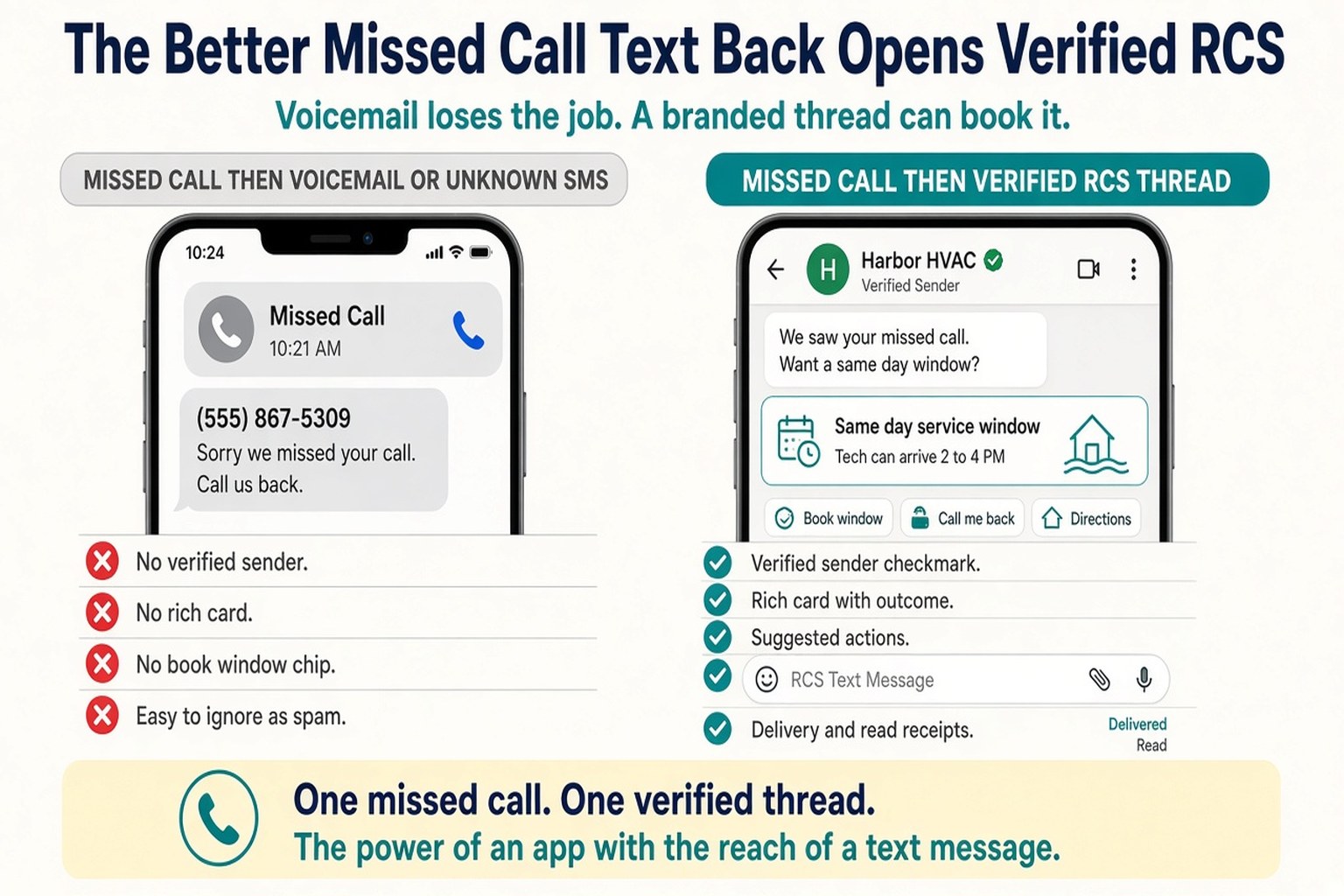
The phone rings once. The caller hangs up. Your team is on a truck, in a consult, or closed for the night. What happens next decides whether that intent becomes a booked job or a voicemail you never return.
Most brands still treat the miss as a dead end. They leave a voicemail. They fire an unknown SMS that says sorry we missed your call. The person is already looking at the next listing. A better missed call text back opens a verified RCS for Business thread in the Messages app they already use, with the power of an app with the reach of a text message.
The miss is a trigger, not a dead end
Google's how it works guide describes business-initiated conversations. The agent sends the first message after an external trigger. A package shipped. A daily offer. A support chat. A missed call is the same pattern. The phone system, the CRM, or the after-hours router fires the event. The launched agent calls the RBM API. The person gets a branded message in native Messages, not a random short code.
That is not the same product as person-to-person RCS. Google's FAQ splits consumer RCS from RCS for Business. Brands work through a partner. MessageOS.ai is an Official Google RBM Partner. We are not Google, and we are not the carrier. Google's first step is still choosing a partner.
RCS is live on all US carriers and on iOS and Android. That is channel availability, not a customer claim, and not a promise that every device gets a rich card. Do not treat a named carrier as a customer. Do not say everyone has RCS.
Why voicemail and bare SMS lose the job
Voicemail asks the caller to leave a recording and wait. Bare SMS from an unknown number looks like spam. Neither shows a verification checkmark. Neither carries a rich card, suggested replies, or suggested actions that book a window in one tap.
RCS versus SMS is the channel comparison operators need. SMS can be two-way. What it lacks, relative to RCS for Business, is the verified business profile and the interactive primitives Google documents in the send messages guide. Dial a number. Create a calendar event. Open a URL. View a location. Share a location. Those chips are how a missed call becomes an outcome instead of a callback list.
Operators also care about delivery receipts, read receipts, and typing indicators. Google's events guide is the citation for those platform events. You know the message landed. You know when they opened it. You know when they are typing a reply. Voicemail gives you none of that.
What the text back should look like
The thread should look like the brand. After brand verification and launch, Google Messages can show a verification checkmark next to the agent name. The first message can be plain text, or a rich card with a clear ask. Suggested replies such as Book a window, Call me back, or Not now. Suggested actions such as DialAction for an immediate callback, Create a calendar event for a booked slot, or Open URL for a scheduling page or portal.
Keep the ask relevant to the miss. Google's Acceptable Use Policy still applies. Consent, STOP, and traffic type are not optional. A missed call text back is a service reply to an inbound attempt, not a cold blast.
Do not put a lock icon on the graphic or on the claim. Person-to-person RCS can show a lock. Business messaging does not. Business RCS is point-to-point and scanned. The trust signal is the verified sender, not a lock. Healthcare reminders can live in the thread only when PHI stays out. Google's data security page is the HIPAA no. Point people to a portal when records are involved. The RCS for healthcare guide is the operator page.
Capability check, then fall back honestly
Before you send a rich card, check reachability. Google's capabilities guide is the citation. A 404 means the user is not reachable by RBM on that network, or the agent is not launched there. The RBM API does not silently rewrite a rich card into SMS. Your stack handles the fallback. See fallback to SMS. Marketing pages that say automatic fallback describe the partner solution, not a silent API rewrite.
What live on a carrier means is the launch gate. Launched is not the same as reachable on every handset. How brands get live with a partner is the path. The public name is RCS for Business. The API still says RBM. The rename did not change the miss-call pattern.
One miss, one thread, every other door
A missed call is one door. MessageOS can set up Search, Maps, ads, a Google Business Profile proof of concept, a QR, sms deep links, a website share-row icon, and the rest of the entry points map. They land in one thread. Click to Message is the product phrase. The operator guide is the longer version. Google's user-initiated post is the citation for Search and Maps message buttons. Click-to-RCS on a Business Profile is a controlled proof of concept. It is not a DIY toggle. GBP Chat is still WhatsApp or SMS on the public field.
That is the Conversation Operating System idea on /conversation-operating-system. The miss, the search tap, and the share-row icon should not invent three inboxes.
Where operators feel it first
An HVAC no-cool on a Saturday. A home services leak after hours. A legal intake call that rings twice and dies. A retail curbside question. A local business booking. Live RCS is the launched thread. Live commerce keeps the sale in Messages. Agencies can put the same agent behind the call tracking they already run. The agencies page is the partner door.
Name dental, restaurants, and auto the same way. Point those teams at RCS for dental, RCS for restaurants, and RCS for automotive. Do not invent solution pages that do not exist. Integrations sit on RCS integrations and Google's webhooks guide.
What to do next
If your missed call path still ends in voicemail or an unknown SMS, rebuild it. The miss should open a verified RCS for Business thread that can book the window, dial back, or hand off to a human with history intact.
Open See Your Brand in Messages if you want the public door. If you want that door on your own brand, contact us or get in touch. An evaluation is available. Bring the call tracking stack and the outcome you want from the first ring that goes unanswered.
The miss is not the end of the conversation. It is the start of the thread.
- What Is RCS Business Messaging?RCS Business Messaging (RBM) is a messaging standard that replaces plain SMS with branded, verified, interactive conversations in the phone's native messaging app. A business is verified with carriers and platform providers, then sends and receives rich content: logo and brand name, rich cards, carousels, suggested replies, images, and real two-way dialogue. Availability depends on the recipient's carrier, device, and operating system, and messages fall back to SMS when RCS is unavailable.
- RCS Integrations: How the Conversation Layer Connects to Your StackMessageOS connects to the systems a business already runs, CRM, scheduling, commerce, support, payments, and analytics, and uses them to answer questions and complete actions inside a messaging thread. Integration happens through those systems' APIs and webhooks, so the agent's real capability is bounded by what each system exposes and what permissions it is granted. MessageOS enhances that stack rather than replacing any part of it.
- RCS vs SMS: What Actually Changes for a BusinessSMS is a universal, plain-text channel with no sender branding and a 160-character frame. RCS adds verified brand identity, rich cards, carousels, suggested replies, richer media, and true two-way conversation, but only where the carrier, device, and OS support it. Most brands run both: RCS where available, SMS as the automatic fallback.
Primary sources worth reading
- RCS Business Messaging developer documentation· Google for Developers
Google's technical reference for RCS Business Messaging: agent registration, rich cards and carousels, suggested replies and actions, capability checks, and webhook events.
Sources and further learning
- How RCS for Business works· official documentation
Business-initiated conversations after an external trigger via the RBM API.
- Send messages with RCS for Business· official documentation
Rich cards, suggested replies, DialAction, calendar, Open URL, and related primitives.
MessageOS Team
· MessageOS.aiMessageOS is the Conversation-to-Outcome Platform, helping brands turn Google Search, AI Search, and click-to-message intent into branded AI conversations that deliver measurable outcomes.