RBM Is Now RCS for Business. The API Did Not Change
On 18 September 2025 Google renamed RCS Business Messaging to RCS for Business. The API did not change. The leftover name on a slide is not a different product.
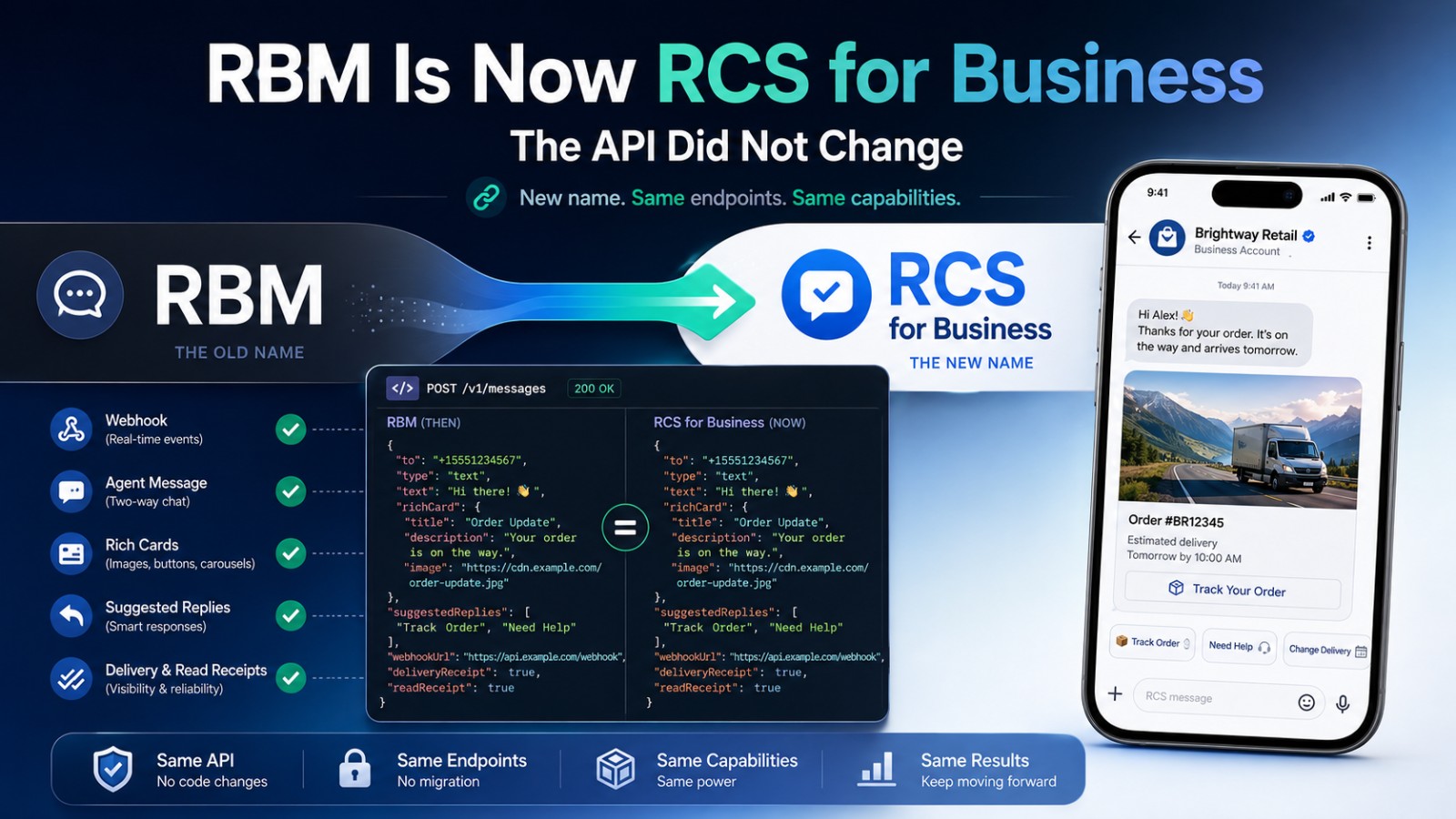
Operators still write RBM on the slide. The phone already shows something else.
On 18 September 2025, Google's past releases said: "To better align with the growing consumer recognition of RCS and to simplify the platform's identity, RCS Business Messaging (RBM) is now officially named RCS for Business." Google called it a change in name, not in function. No technical changes to the platform. No material changes to terms, policies, or existing contracts.
That leftover name is not a second product. What you call it in a deck, what the API still says, what support still answers, and what the customer sees in Messages are four labels for one launched agent.
What changed. What did not.
Google listed both sides.
Changing: the marketing site and assets. The developer site, in the non-API sections. Terms of Service, the Acceptable Use Policy, and new or renewed contracts.
Not changing: the support email stays rbm-support@google.com. API names and endpoints stay as they are. Existing contracts will not be amended.
Google also said do not invent new acronyms. Do not write R4B or RCSB. Use RCS for Business on new materials. RBM remains a familiar shorthand.
That is why this post uses RCS for Business in the copy, and RBM API only when the interface is the subject. The glossary entry still defines RBM as if it were Android only. Our Learn page still titles the product RCS Business Messaging. The current sites say Android and iOS. Link those pages anyway. Fix the name here.
Person to person RCS is a different product
Google's FAQ splits the two. RCS is the industry standard on Android and iOS where a carrier supports it. RCS for Business is the product built so a company can send branded, interactive messages for marketing, support, and sales, and so a customer can start that thread.
Person to person RCS is the consumer upgrade between people. Read receipts and typing indicators in a green bubble are not a launched brand agent. The rename is about the business product. It is not a rename of texts between two people.
RCS versus SMS is still the channel comparison. The rename does not change that split.
Four labels, one agent
Keep the labels in their lanes.
Public name: RCS for Business. Put that on the website, the RFP response, and the new contract.
API name: RBM API. phones.agentMessages.create still lives on rcsbusinessmessaging.googleapis.com. Webhooks and error codes still say RBM. Do not change your code because a slide got a new title.
Support: rbm-support@google.com. That address did not move.
What the customer sees: a verified sender in native Messages. Not the letters RBM. Not a lock icon.
Business RCS is point to point and scanned. It is not end to end encrypted. It is not HIPAA. A healthcare reminder can live in the thread. PHI cannot.
RCS is live on all US carriers and on iOS and Android. That is channel availability. It is not a customer claim, and it is not a promise that every device will render a rich card. What live on a carrier means is the launch versus reachable split. iPhone versus Android is the client split. Neither is a naming problem.
When the thread does open, it can carry the power of an app with the reach of a text message: a verified sender, read receipts, delivery receipts, typing indicators, rich cards, and suggested actions.
The leftover name in the RFP is not a different stack
Legal, agencies, HVAC, home services, healthcare, retail, and local shops still get decks that say RBM. That is the old product name. It is the current API name. It is not a second channel.
An HVAC Saturday no-cool does not care what the slide says. A home services window, a legal intake, a retail pickup, live commerce in Messages, or a local business booking all need one launched agent. Live RCS is that launched thread. Agencies can put the same agent behind the work they already run. The agencies page is the partner door.
Google's FAQ is blunt. Businesses must use a partner to connect and send rich messages. The first step on Google's site is choosing a partner. MessageOS is an Official Google RBM Partner. We are not Google, and we are not the carrier. How brands get live with a partner is that path. This post is not that recap. The rename did not change the partner model.
MessageOS can set up Search, Maps, ads, a Google Business Profile proof of concept, a QR, sms deep links, a missed call text back, a website share-row icon, and the rest of the entry points map. They land in one thread. Click-to-RCS on a Business Profile is a controlled proof of concept. It is not a DIY toggle.
A restaurant, a dental office, or an auto shop is the same pattern. The Learn guides walk those verticals. The thread is still one launched agent.
MessageOS.ai is not a WhatsApp product, and it is not the overseas company that uses the same name.
What to do next
If your deck still says RBM, keep the API name where the API is the subject. Use RCS for Business everywhere the customer, the RFP, or the new contract will see it.
Open See Your Brand in Messages if you want the public door. If you want that door on your own brand, contact us or get in touch. An evaluation is available. Bring the leftover slide, the agent you already have or do not, and the outcome you want from the first tap.
The name on the slide can lag. The conversation does not have to.
- What Is RCS Business Messaging?RCS Business Messaging (RBM) is a messaging standard that replaces plain SMS with branded, verified, interactive conversations in the phone's native messaging app. A business is verified with carriers and platform providers, then sends and receives rich content: logo and brand name, rich cards, carousels, suggested replies, images, and real two-way dialogue. Availability depends on the recipient's carrier, device, and operating system, and messages fall back to SMS when RCS is unavailable.
- RCS Integrations: How the Conversation Layer Connects to Your StackMessageOS connects to the systems a business already runs, CRM, scheduling, commerce, support, payments, and analytics, and uses them to answer questions and complete actions inside a messaging thread. Integration happens through those systems' APIs and webhooks, so the agent's real capability is bounded by what each system exposes and what permissions it is granted. MessageOS enhances that stack rather than replacing any part of it.
- AI Search to Conversation: The New Path to a CustomerAI search changes the customer journey from query, click, browse, convert into query, answer, act. When an assistant answers in place, the website visit may never happen, so the practical goal is to be understandable to AI systems and to offer a next step that works without a website session. A messaging thread is that next step: it starts instantly, needs no account, and can carry the outcome to completion.
Primary sources worth reading
- RCS Business Messaging developer documentation· Google for Developers
Google's technical reference for RCS Business Messaging: agent registration, rich cards and carousels, suggested replies and actions, capability checks, and webhook events.
- RCS for Business blog· Google
Google's official program blog for RCS Business Messaging, covering feature releases, brand case studies, and carrier rollout news.
Sources and further learning
- Past releases (2019-2025)· official documentation
Google's 18 September 2025 release note renaming RCS Business Messaging (RBM) to RCS for Business, a name change not a function change.
- Frequently Asked Questions on RCS for Business· product resource
Google FAQ splitting RCS from RCS for Business, and stating businesses must use a partner.
MessageOS Team
· MessageOS.aiMessageOS is the Conversation-to-Outcome Platform, helping brands turn Google Search, AI Search, and click-to-message intent into branded AI conversations that deliver measurable outcomes.