RCS for Business: What Live on a Carrier Actually Means
Launched is not the same as reachable. Here is what live means for an RCS for Business agent, and what still has to be true before a rich card can land.
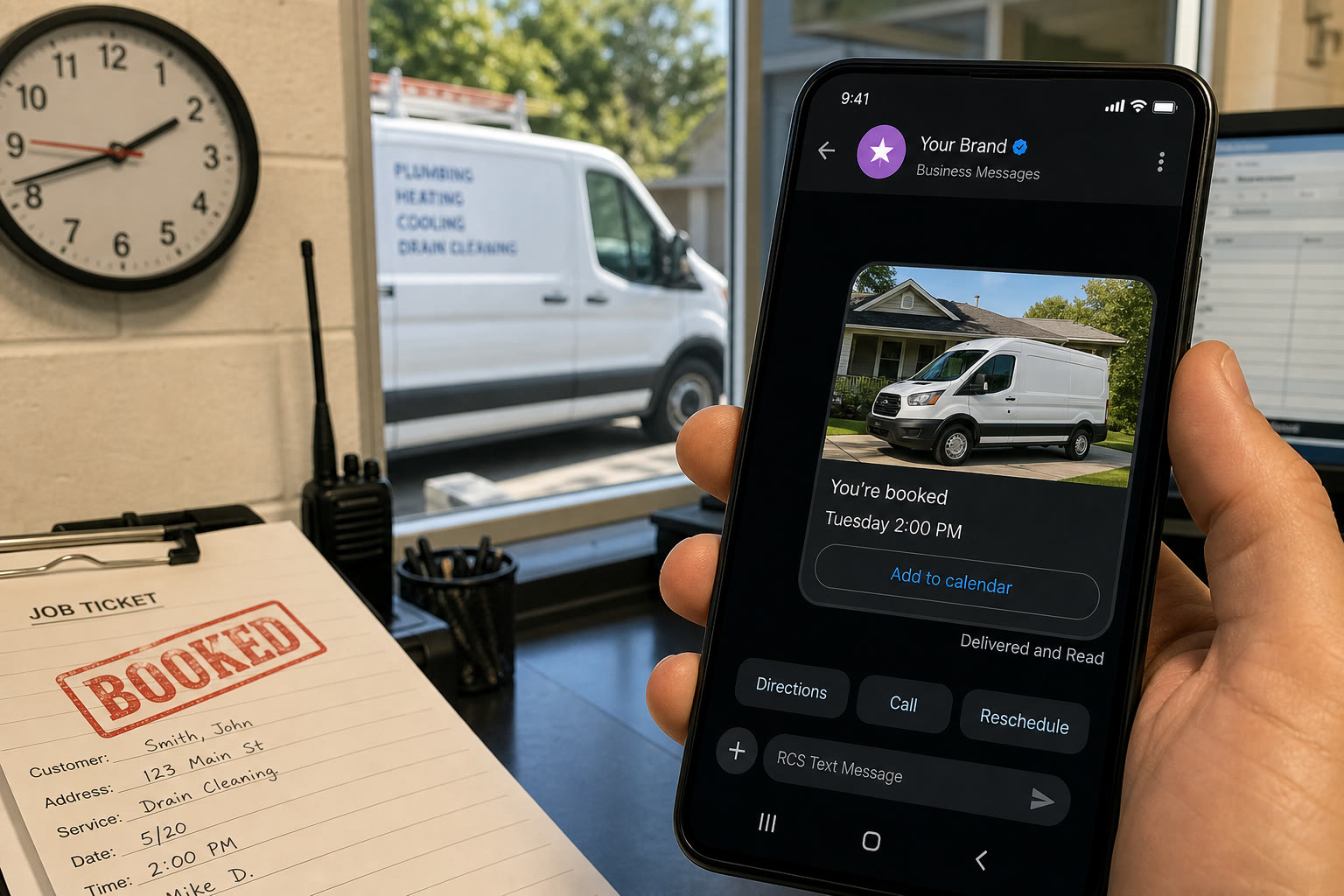
Live does not mean every phone on a US network will get your rich card. It means a partner launched your agent on that network, and this phone can take RCS right now. But this is changing quickly.
That gap is why brands get disappointed. Someone says RCS is live on all US carriers, and on iOS and Android, which is true as availability. Then a homeowner's thread never opens, or the card dies, and the shop decides the channel is fake. The channel is not fake. Live and reachable are two different jobs.
MessageOS is an Official Google RBM Partner. We launch the agent. We also have to catch the phones that cannot take the card. That is the work behind how brands get RCS for Business live.
Launched is a network yes. Reachable is a phone yes.
An RCS for Business agent cannot message a person on a network until it is launched on that network. Google's launch docs are the source for that gate. Some launches Google reviews. Some the network reviews, and they will not approve a partner with no relationship in place.
Launched means messages are allowed there. It does not mean every subscriber can receive RCS. It does not mean every Android or iPhone will render a carousel. RCS is live on all US carriers, and on iOS and Android. A given phone still has to have RCS on.
Think of an HVAC Saturday no-cool. The agent can be live. The homeowner can still have RCS off, or a device that has not talked to RCS in weeks. Local businesses feel this as silence. Silence is not always a dead agent. Sometimes it is a phone the agent cannot see.
What a reachability check actually tells you
Google's capability guide is the operator version of this. A check only sees a number if that phone has connected to RCS in about the last 31 days. Online devices check in every few hours. The result is a cache. It is not a promise they will read you this minute.
A 404 means one of two things. The phone is not reachable over RCS, RCS is off, or the device does not support it. Or the phone can do RCS, and your agent is not launched on that network.
That is why Click to Message and a website icon still need a launched agent. An sms deep link on a site, a QR, a missed-call text-back, Search, Maps, ads, a Business Profile proof of concept: all of those entry points open the same thread. None of them create the launch.
Do not treat a yes on the check as consent. Consent is separate. Do not treat a yes as "they have the rich card." The check can say reachable. The card can still be more than that device supports.
Fallback is your job. The card does not become SMS by itself.
RCS for Business marketing copy says a message that cannot go as RCS falls back to SMS or MMS so it still goes through. Google's how-it-works guide says something stricter. If the device does not support RCS, the platform returns a 404, and the agent should fall back to another path, such as SMS. If you send a feature the device does not support, the send fails and the message is not delivered.
Those two sentences are both official. They are not the same. The API does not silently turn a rich card into a text. A fallback that keeps the conversation alive is partner software. MessageOS has to do that. A rich card cannot arrive as a rich card on SMS. The job ticket can. The tap to Add to calendar cannot.
That is still the power of an app with the reach of a text message. When the phone can take RCS, the thread has a verified sender, read receipts, delivery receipts, typing indicators, rich cards, carousels, and suggested actions. When it cannot, the person should still get a thread, not a void.
For home services, that is a booked window even if the card never renders. For legal, that is intake. For healthcare, that is an appointment without PHI in the thread. For retail, that is the order. For agencies, that is the conversion layer you can sell without promising every phone a carousel.
What you can say is live, and what you should not
You can say the agent is launched on US networks. You can say RCS is live on all US carriers, and on iOS and Android. You can say a delivered RCS message can show read receipts. You can say MessageOS will fall back when the card will not send.
You should not say everyone has RCS. You should not say an iPhone or an Android is enough. You should not say fallback is lossless. You should not say a reachability check means they opened it. You should not put a lock on a business thread. Business RCS is scanned. It is not end-to-end encrypted.
Named brand experiences on the site are unofficial conceptual simulations. They are not customers, not partners, and not live deployments. MessageOS.ai is not the overseas WhatsApp company.
The Conversation Operating System is how one launched agent serves every door. What RCS Business Messaging is still uses the older product name. The current external name is RCS for Business. The API still says RBM.
What to do next
If your team says we are live and the phones are quiet, ask which networks the agent is launched on, and what happens on a 404. That is the scorecard. Not a logo on a slide.
Contact us or get in touch and ask us to walk your numbers. An evaluation is available. Bring a vertical, a test set of phones, and the outcome you want from the first tap, book, intake, order. We will tell you what live means for those phones, and we will put the thread behind the entry points you already pay for.
See the conversation in Messages when you are ready. The agent has to be launched first. Then the card can land. Then the job can get stamped booked.
- What Is RCS Business Messaging?RCS Business Messaging (RBM) is a messaging standard that replaces plain SMS with branded, verified, interactive conversations in the phone's native messaging app. A business is verified with carriers and platform providers, then sends and receives rich content: logo and brand name, rich cards, carousels, suggested replies, images, and real two-way dialogue. Availability depends on the recipient's carrier, device, and operating system, and messages fall back to SMS when RCS is unavailable.
- RCS for Automotive: Dealers, Service Lanes, and AftersalesFor automotive, RCS Business Messaging turns anonymous dealership texts into a verified, branded conversation that can carry vehicle photos, service options, appointment slots, and status updates as rich, tappable content. Typical uses are lead response, test drive scheduling, service booking and status, recall and maintenance reminders, and aftersales follow-up. What can be automated depends on what your DMS, CRM, and scheduling systems expose.
- RCS vs SMS: What Actually Changes for a BusinessSMS is a universal, plain-text channel with no sender branding and a 160-character frame. RCS adds verified brand identity, rich cards, carousels, suggested replies, richer media, and true two-way conversation, but only where the carrier, device, and OS support it. Most brands run both: RCS where available, SMS as the automatic fallback.
Primary sources worth reading
- RCS for Business blog· Google
Google's official program blog for RCS Business Messaging, covering feature releases, brand case studies, and carrier rollout news.
- CTIA Messaging Principles and Best Practices· CTIA
US carrier guidance on consent, opt-out handling, and acceptable message content for business messaging programs.
Sources and further learning
- RCS for Business capability checks· official documentation
Google's guide to reachability, the 31-day window, and what a 404 means.
- RCS for Business· product resource
Google's brand overview, including fallback language when RCS cannot be delivered.
MessageOS Team
· MessageOS.aiMessageOS is the Conversation-to-Outcome Platform, helping brands turn Google Search, AI Search, and click-to-message intent into branded AI conversations that deliver measurable outcomes.