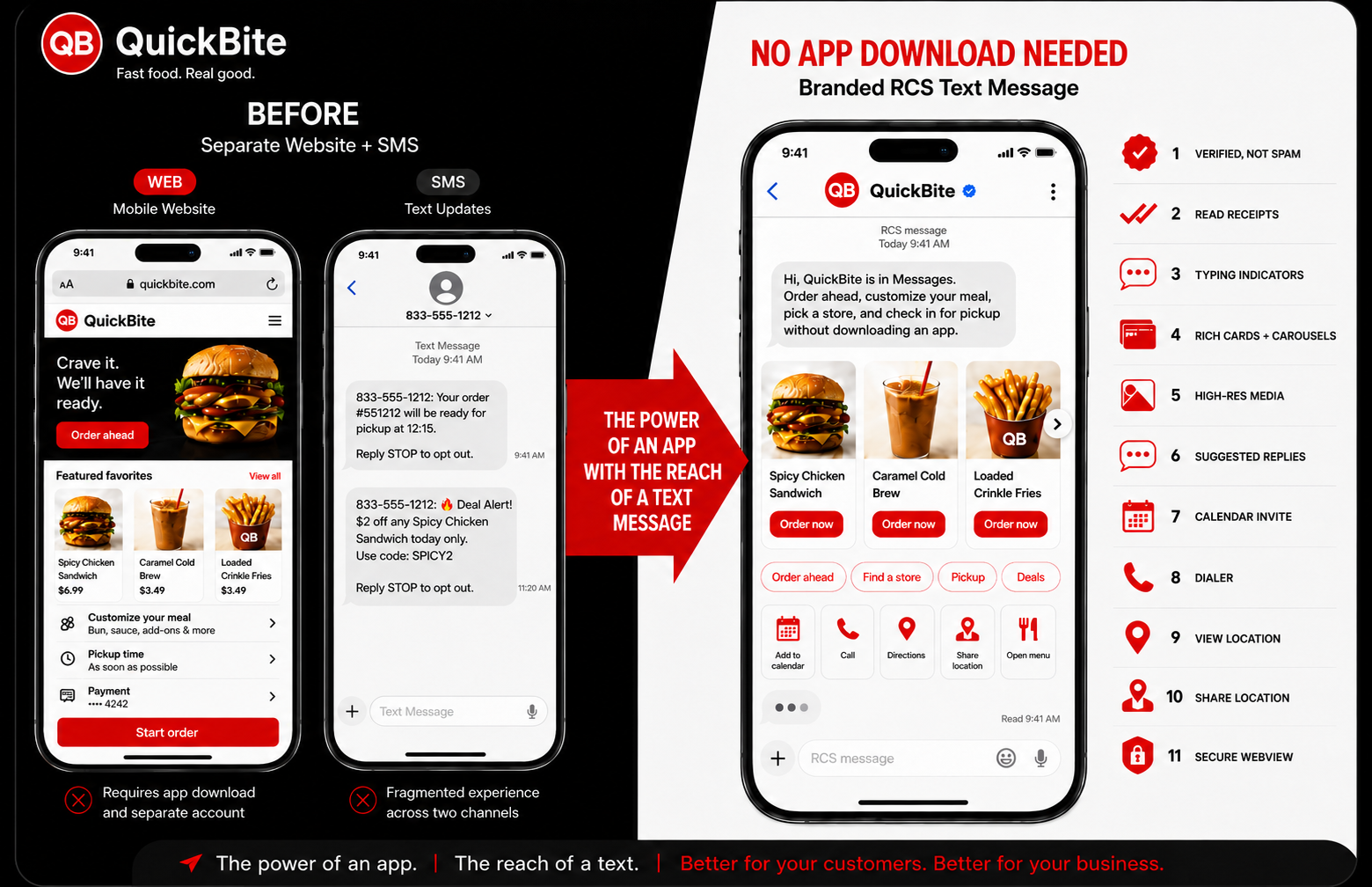
Why restaurants are a natural fit for RCS
Restaurants get hammered with the same inbound questions every service: hours, address, parking, reservations, gluten-free options, kid menu, large parties, catering, gift cards, where's my Uber Eats order. Most of these touch the host stand during the worst possible moment, the pre-rush. The cost is not just labor, it is hospitality leak: a host fielding a phone call cannot greet the family waiting at the door.
RCS Business Messaging plus an AI agent absorbs that load. A diner texts the restaurant, the agent answers in the brand voice with the logo and verified checkmark visible, books the table, sends a rich-card confirmation with a map and a one-tap modify button, and texts a wait-time update if the dining room runs behind. The host stand stays focused on the guests physically in the room.
What changes for the operator
Three structural shifts:
- Inbound calls drop 40-60% within 60 days. The "what time do you close on Sunday" calls vanish; only the calls that need a human remain.
- No-show rate falls. A rich-card reservation confirmation with a one-tap "I'll be there" or "cancel" reminder, sent two hours out, recovers seats that would otherwise sit empty.
- Repeat-visit frequency climbs. Once guests text once, you have a verified channel for tasteful, opt-in re-engagement: the new fall menu carousel, a birthday rich card, a one-tap reorder of last week's takeout.
For a single location doing $3M in revenue, recovering a 5% no-show rate alone is roughly $150K a year. Multi-unit operators compound this across every store.
What RCS actually looks like in a restaurant flow
A guest scans a QR on the table tent or taps the number on Google. Their messages app opens, the conversation begins:
- Greeting from the verified restaurant. Logo, name, checkmark.
- Intent triage. Reserve, order takeout, ask a question, gift card, catering. Tappable buttons.
- For reservations. Party size and date as suggested replies, time slots as a rich-card carousel pulled from the live res system (OpenTable, Resy, SevenRooms, Yelp Reservations). One tap to book.
- Confirmation. Rich card with date, time, party size, map, one-tap modify or cancel.
- Pre-arrival. Two-hour reminder with a one-tap confirm. If the guest taps cancel, the slot returns to inventory in real time.
- For takeout. Menu as a rich-card carousel, order built inside the thread, payment handled via the restaurant's existing POS or third-party order rail, pickup time confirmed.
- Post-visit. Optional one-tap review request, loyalty signup, or "save your order" prompt for next time.
The entire arc happens in one thread, with the restaurant's brand verified. No app to install, no portal, no email confirmation that gets buried.
Why RCS beats SMS and third-party delivery apps for direct guest relationships
SMS works, but it is unbranded and text-only. Third-party delivery apps (DoorDash, Uber Eats, Grubhub) own the guest relationship and take 20-30% of the ticket. RCS is the first channel that gives a restaurant a direct, branded, two-way conversation with the diner without surrendering margin.
- Rich cards replace menu PDFs. A swipeable carousel of tonight's specials with photos converts dramatically better than a link to a PDF menu.
- Suggested replies make modification trivial. "Add a side Caesar?" with a one-tap yes turns into a $7 add-on the diner would never have asked for.
- Verified sender kills "is this real?" friction. Restaurants are routinely impersonated for fake gift card and reservation scams. A verified checkmark next to the brand name flips suspicion to engagement.
For phones that don't yet support RCS, messages fall back to SMS automatically.
Where AI fits
The Ezra agent holds the restaurant's full playbook: live reservation availability, the current menu with mod codes and allergens, your no-show and large-party policies, your catering minimums, your gift card pricing, the hours and exceptions for holidays and private events. It runs the conversation, escalates to a human (a manager's phone) when something falls outside the rules, and writes outcomes back into your reservation system and POS.
For multi-unit operators, the same agent handles every location with location-specific data underneath: a guest texting the corporate number reaches the agent, the agent figures out which store based on the message or asks once, and the rest of the conversation happens against that store's live inventory.
What it takes to launch
A single location can be live in about two to three weeks; a 20-unit operator typically takes 3-4 weeks for the full rollout:
- Brand verification. We file the business with the major carrier networks so the verified checkmark, logo, and name show on every supported phone.
- Agent build. We map your reservation system, menu, POS, and host-stand scripts into the agent. No code on your end.
- Number setup. Use the existing restaurant phone number or add a new RCS-capable line; inbound texts route to the agent with one-tap handoff to a manager.
- Pilot at one location. First two weeks in shadow mode (agent drafts, host approves), then autonomous with a takeover button.
- Roll out the fleet. Each location goes live in days once the playbook is proven.
Expect 30-40% deflection of inbound host-stand calls in month one, and a meaningful lift in repeat-visit frequency by month three.
See it working
We have live demos for restaurant brands you can text yourself in 30 seconds. Watch how the agent handles a reservation, a takeout order, a large-party request, and a same-day cancellation.