Add a Website Icon That Opens RCS, Not a Social Feed
Every other icon in the share row ships visitors to a feed. One more icon opens a verified RCS conversation in Messages and keeps the outcome with you.
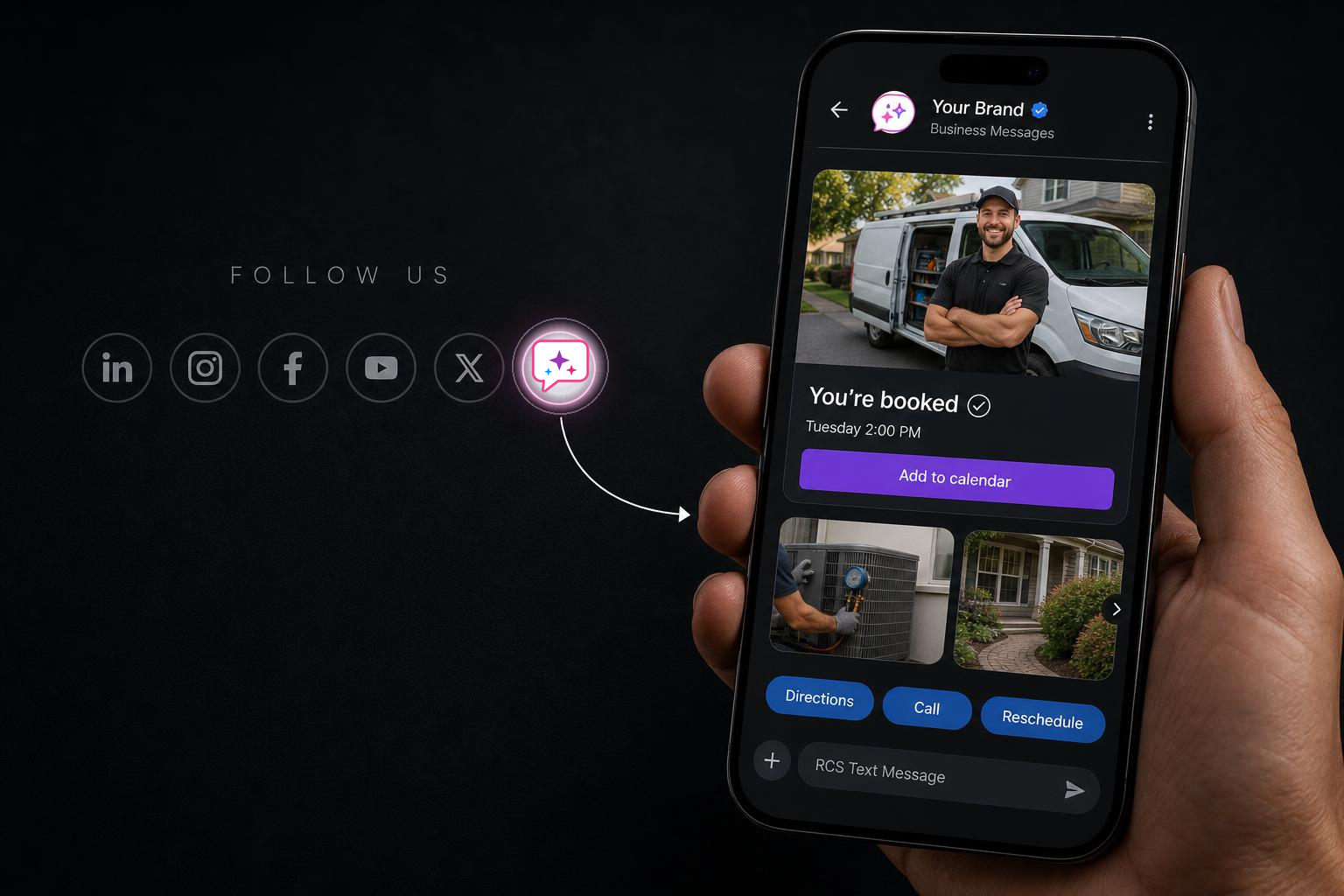
Every other icon in your share row ships a visitor to a feed. One more icon can open a verified conversation in Messages and keep the outcome with you.
That is social to conversation: a MessageOS icon in the row people already scan. LinkedIn, Instagram, Facebook, YouTube, and X are distribution. They are good at that. They are also exits. The visitor who came to book, order, or ask a real question leaves your site and lands in an algorithm.
The MessageOS icon does the opposite. One tap opens the native Messages app, prefilled, into a branded RCS for Business thread. No download. No web redirect. RCS is live on all US carriers, and on iOS and Android. That is the power of an app with the reach of a text message.
The share row was built to send people away
A follow row is a distribution tool. It was never a conversation system.
A restaurant guest who opens your site from burger near me is not looking for your Instagram grid. An HVAC homeowner who made it to your service page is not looking for a LinkedIn company update. A parent on a law firm site is not looking for a YouTube trailer. They already have intent. The row still offers them five ways to leave.
WhatsApp click-to-chat already lives in that row for a lot of sites. That tap still opens WhatsApp, or WhatsApp Web. Messenger does the same for Messenger. Those are apps. MessageOS.ai is not a WhatsApp product, and it is not the overseas MessageOS that is. This icon opens the Messages app already on the phone.
Click to Message is the product name for that tap. The Click-to-Message operator guide is the longer version. The share-row icon is one placement. Entry points is the rest: Search, Maps, ads, a QR, a missed-call text-back, a Google Business Profile proof of concept. One thread.
What the tap actually is
This is not a widget that opens a site chat. It is not Google's public Chat field on a Business Profile, which is still WhatsApp or SMS. That post is the listing version. This is a website entry point into a launched RCS agent.
Google documents how a user starts a conversation from an SMS deep link you can embed on a site, in an email, in an app, or in a QR. Success needs Messages with RCS on, and an agent that is launched on that person's network. If those fail, a fallback number in the URL can catch them. If they fail and there is no fallback, they see an error.
So the icon is not magic. The agent has to be live. How brands get RCS for Business live is the partner path. MessageOS is an Official Google RBM Partner. We create the agent, verify the brand, launch it, and put the icon on the surfaces you already have.
Do not write first of its kind. The mechanic is a documented deep link. What you are adding is the job after the tap.
What the thread has to finish
A verified checkmark is not the outcome. The booked job is.
RCS for Business is a branded, two-way thread in the native messaging app, with your name, logo, and suggested actions. The thread can carry read receipts, delivery receipts, typing indicators, rich cards, carousels, and suggested actions. Availability still depends on the device having RCS on, and on the agent being launched. A rich card will not render on every phone. Fallback still matters.
Inside that thread, a Branded AI Concierge greets in your voice. Capability Discovery is how it learns what you actually offer. Outcome Connectors pass a booking, a ticket, or a lead into the system you already run. Live Business Mode is the difference between a canned reply and a thread that knows hours, service area, and what you can do today.
For HVAC, the tap from a service page becomes an estimate conversation, not a brochure. For home services, it becomes a booked window. For legal, it becomes intake. For healthcare, it becomes an appointment without putting PHI in the thread. For retail, it becomes a purchase or a return visit. For agencies, it is a conversion layer you can drop into the sites you already build, next to the icons your clients already pay to fill.
A local business already paid for the visit. The row should not donate that visit to a feed.
Keep the other icons. Add the one that talks.
Do not rip out LinkedIn. Do not hide Instagram. Those channels still have a job.
The MessageOS icon sits at the end of that row, on the header, the footer, a blog post, a product page, a campaign landing. One snippet. The same verified agent. The visitor who wants to follow you can still follow you. The visitor who wants a Tuesday window, a consult, or a pickup ticket should not have to hunt a form.
That is why this belongs next to Search to Conversation without rewriting it. Search is one door. The site is another. The Conversation Operating System is how both land in one thread. What RCS Business Messaging is still uses the older product name. The current external name is RCS for Business.
Named brand experiences on the site are unofficial conceptual simulations. They are not customers, not partners, and not live deployments.
What to do next
Look at your own header on a phone. Count the icons that send people away. Then open the one social icon that keeps visitors talking and watch the difference.
If you run the site, or you run Search for someone who does, contact us or get in touch and ask to put that icon on a real property. An evaluation is available. Bring the URL, the outcome you want from the first tap, and the vertical.
MessageOS can stand up the agent and the entry points. The share row is the one your visitors already trust. Give them one icon that can finish the job.
- What Is RCS Business Messaging?RCS Business Messaging (RBM) is a messaging standard that replaces plain SMS with branded, verified, interactive conversations in the phone's native messaging app. A business is verified with carriers and platform providers, then sends and receives rich content: logo and brand name, rich cards, carousels, suggested replies, images, and real two-way dialogue. Availability depends on the recipient's carrier, device, and operating system, and messages fall back to SMS when RCS is unavailable.
- AI Search to Conversation: The New Path to a CustomerAI search changes the customer journey from query, click, browse, convert into query, answer, act. When an assistant answers in place, the website visit may never happen, so the practical goal is to be understandable to AI systems and to offer a next step that works without a website session. A messaging thread is that next step: it starts instantly, needs no account, and can carry the outcome to completion.
- Click to Message: Turning a Tap Into a ConversationClick to Message is an entry point that opens the phone's native messaging app with a conversation already addressed, and usually pre-filled, so the customer only has to press send. It can be placed on a website, a search result, an ad, a QR code, an email, a social profile, or a physical sign. It works because the customer stays in an app they already trust instead of loading a new page or filling in a form.
Primary sources worth reading
- RCS Business Messaging developer documentation· Google for Developers
Google's technical reference for RCS Business Messaging: agent registration, rich cards and carousels, suggested replies and actions, capability checks, and webhook events.
- RCS for Business blog· Google
Google's official program blog for RCS Business Messaging, covering feature releases, brand case studies, and carrier rollout news.
Sources and further learning
- Start a conversation from an SMS deep link· official documentation
Google's guide to embedding an sms deep link on a website, email, app, or QR so a user can start an RCS for Business conversation.
- RCS for Business· product resource
Google's brand overview of verified senders, rich media, and two-way conversations in Messages.
MessageOS Team
· MessageOS.aiMessageOS is the Conversation-to-Outcome Platform, helping brands turn Google Search, AI Search, and click-to-message intent into branded AI conversations that deliver measurable outcomes.