Brand Verification Comes Before Your First RCS Launch
Brand verification is required before the first RCS for Business launch. After launch, Google Messages can show a verification checkmark. Partners cannot self-apply the badge.
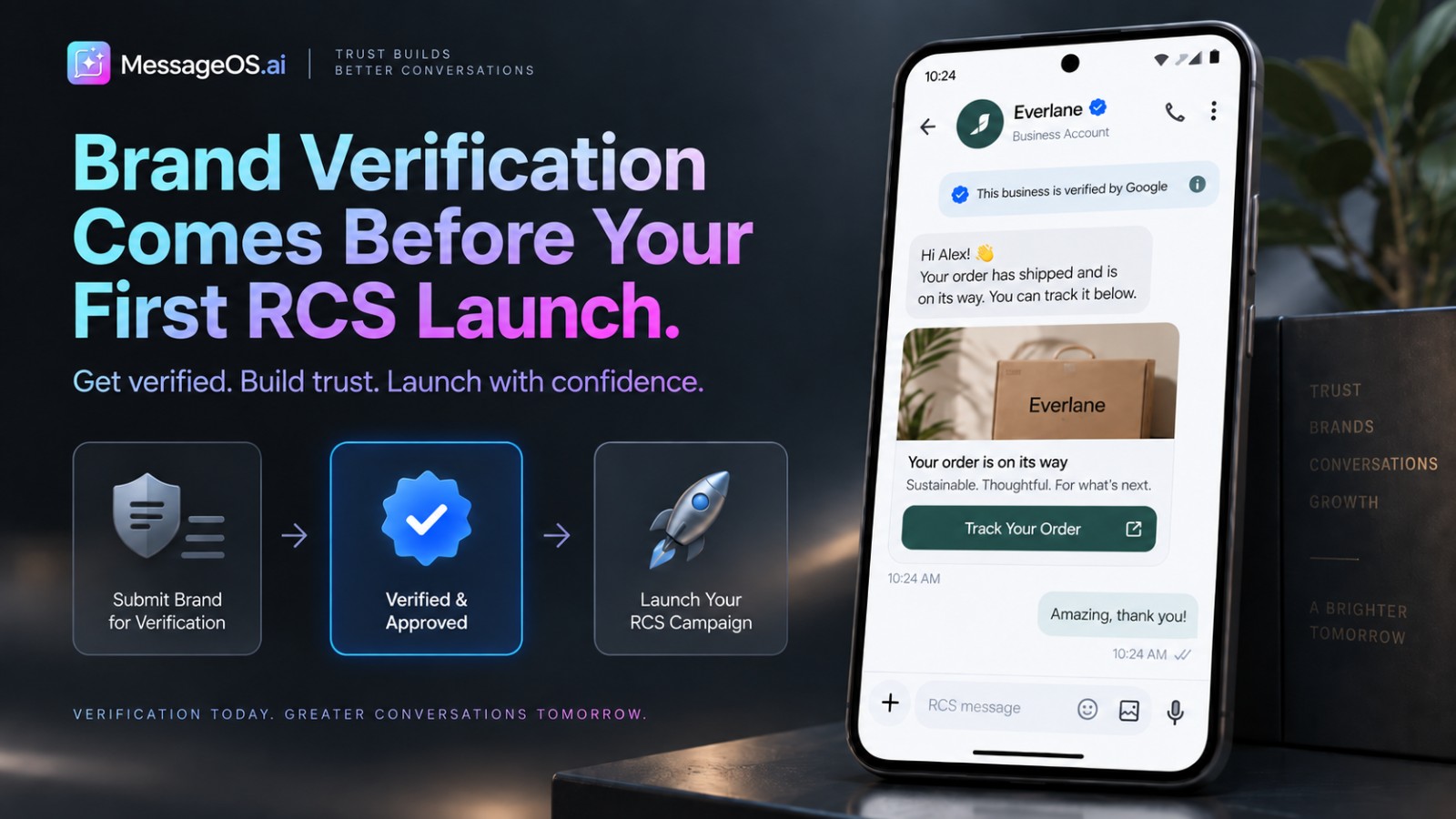
Brand verification is not a marketing badge a partner can toggle on. Google requires it before the first RCS for Business launch. An authorized brand representative verifies the agent information and the partner's right to manage the agent. Verification information is submitted once per agent, before the first launch request. After the agent completes verification and launches, Google Messages can display a verification checkmark next to the agent name. Conversation Details can also show that the sender was verified and which entity verified them. Partners cannot self-apply the badge.
That is the whole claim. Verification first. Launch next. Checkmark on Google Messages after launch. Pair MessageOS verified sender with Google's brand verification guide when you brief a brand or an agency.
RCS is live on all US carriers and on iOS and Android. That is channel availability, not a customer claim, and not a promise that every device gets a rich card. When the client can take it, RCS for Business gives you the power of an app with the reach of a text message: a verified sender, delivery receipts, read receipts, typing indicators, rich cards, and suggested replies and actions. Verification is how the inbox proves the brand behind those primitives.
What an agent is, and why verification attaches to it
An agent is a programmatic entity that represents a brand. The messaging app shows name, logo, description, contact information, and URLs. MessageOS explains the same idea on what is RCS for Business. Use case is locked when you submit for launch (OTP, transactional, promotional, or multi-use). Verification is separate from use case, but it sits on the same agent record. One agent. One verification submission before first launch. Do not treat the checkmark as a content-quality seal. It proves sender authenticity after launch on Google Messages, not that every message is marketing-safe.
Google's Acceptable Use Policy requires the publicly branded business name, accurate and up-to-date business information, and the legal business name of the brand that owns the agent when you create it. Name accuracy is part of trust. It is not optional copy polish.
Partners manage. Brands authorize. Google and carriers approve.
Businesses reach RCS for Business through a partner. Google's Find a partner page says partners provide the APIs and expertise and manage carrier connections. MessageOS talks as a partner, not as Google and not as a carrier. See the same partner-first framing on what is RCS for Business. The brand does not "turn on RCS in Google." The brand picks a partner. The partner creates the agent. An authorized brand representative confirms agent info and the partner's right to manage it. Google and/or carriers then contact the brand point of contact as part of launch. For Google-managed launches the brand is contacted once. For carrier-managed launches each carrier may contact the brand.
Do not invent timelines. The sourced rule is order of operations: submit verification once per agent before the first launch request, then launch, then the Google Messages checkmark can appear. Do not claim the checkmark on every client, every carrier, or before launch.
Trust signals are not the whole product
Google's trust and spam post frames verification as part of a regulated, scanned channel. Pair that with verified sender. Business RCS is not end-to-end encrypted. See security. It is not HIPAA compliant. Keep PHI out of the thread. For appointment patterns without PHI, use healthcare and RCS for healthcare.
Once the agent is live, events include DELIVERED, READ, and IS_TYPING, plus suggestion postbacks and unsubscribe. Those receipts and indicators are native Messages capabilities MessageOS teaches next to the verified profile on what is RCS for Business. Verification gets the brand into the inbox as authentic. Events tell operators what happened next.
Entry points still need a verified agent first
MessageOS wires entry points so Search, Maps, ads, a Business Profile proof of concept, QR, sms: deep links, missed-call text-back, and a website share-row open one verified agent thread. Click to Message and Search to Conversation are doors into that agent. Official deep-link behavior lives in Google's deeplinks guide and MessageOS click to RCS plus /entry-points. Click to RCS on a Google Business Profile remains a controlled proof of concept through MessageOS. Public Business Profile Chat is still WhatsApp or SMS. Either way, the agent behind the door still needs brand verification before first launch.
How this shows up by vertical
- HVAC and home services. A booked tech visit from a missed-call thread should show a verified brand name, not a bare number.
- Retail. Pickup and stock cards land harder when Google Messages can show the checkmark after launch.
- Legal. Intake from ads needs a verified agent the firm authorized, not a partner-only badge.
- Agencies. Brief clients that verification is a launch gate. Partners cannot self-apply the checkmark.
- Local business. Multi-location brands still verify per agent before first launch. See the conversation operating system.
- Healthcare (example). Reminders without PHI still sit on a verified agent. Use RCS for healthcare.
- Restaurants, dental, auto (examples). Same order of operations via RCS for restaurants, RCS for dental, and RCS for automotive.
Compare channel basics in RCS vs SMS. For live handoff patterns after the agent is verified and launched, see live RCS. MessageOS.ai is not the overseas WhatsApp company.
What to do next
Treat brand verification as a launch prerequisite, not a post-launch cosmetics step. Confirm the brand point of contact. Submit verification once per agent before the first launch request. Plan entry points into that same verified agent. Then contact MessageOS or request a preview. Evaluation is available. Bring the vertical, the entry points you care about, and the outcome you want when RCS lands: book, quote, order, or live handoff. We will stand up the agent, walk brand verification before first launch, and keep every door in one verified thread.
- What Is RCS Business Messaging?RCS Business Messaging (RBM) is a messaging standard that replaces plain SMS with branded, verified, interactive conversations in the phone's native messaging app. A business is verified with carriers and platform providers, then sends and receives rich content: logo and brand name, rich cards, carousels, suggested replies, images, and real two-way dialogue. Availability depends on the recipient's carrier, device, and operating system, and messages fall back to SMS when RCS is unavailable.
- AI Search to Conversation: The New Path to a CustomerAI search changes the customer journey from query, click, browse, convert into query, answer, act. When an assistant answers in place, the website visit may never happen, so the practical goal is to be understandable to AI systems and to offer a next step that works without a website session. A messaging thread is that next step: it starts instantly, needs no account, and can carry the outcome to completion.
- RCS vs SMS: What Actually Changes for a BusinessSMS is a universal, plain-text channel with no sender branding and a 160-character frame. RCS adds verified brand identity, rich cards, carousels, suggested replies, richer media, and true two-way conversation, but only where the carrier, device, and OS support it. Most brands run both: RCS where available, SMS as the automatic fallback.
Primary sources worth reading
- RCS for Business FAQ· Google
Google's official answers on RCS availability, brand verification, device and carrier support, and how RCS differs from SMS.
Sources and further learning
- Brand verification | RCS for Business· official documentation
- Building trust and blocking spam with RCS for Business· article
MessageOS Team
· MessageOS.aiMessageOS is the Conversation-to-Outcome Platform, helping brands turn Google Search, AI Search, and click-to-message intent into branded AI conversations that deliver measurable outcomes.