How Agencies Wire Google Ads into RCS for Business
Agencies keep the Google Ads account. Upgrade the destination from a form to a verified RCS for Business thread in Messages, with Message Ads Early Access and deep links that work today.
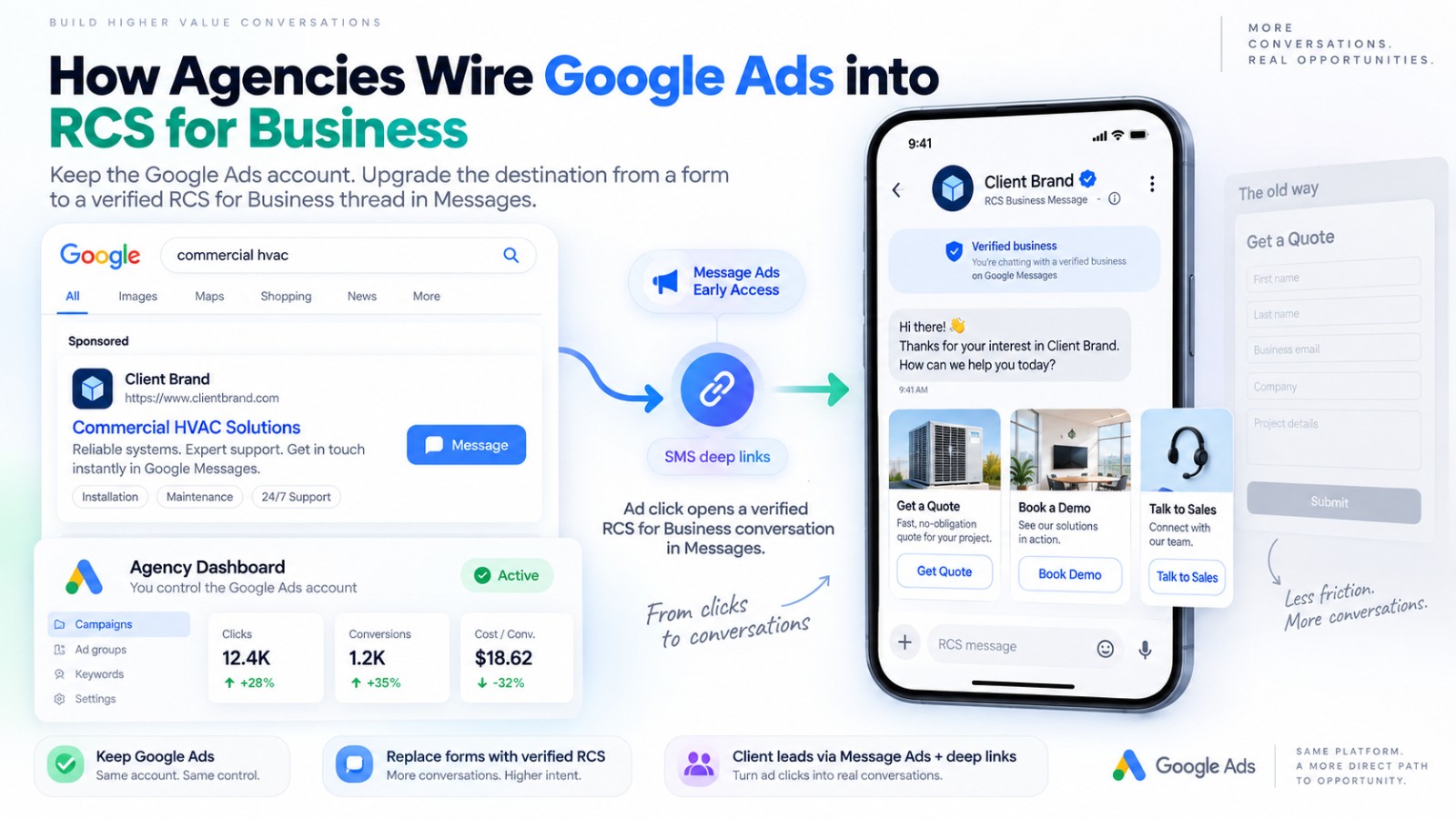
Most agency stacks still spend Google Ads dollars to win a click, then dump that click into a form, a chat widget, or a 10-digit SMS short code. The media plan works. The destination wastes it.
The fix is not a new ads account. It is a better destination. Keep the Google Ads account, the local SEO program, and the CRM you already report into. Upgrade what the tap opens to a verified RCS for Business thread in the native Messages app. That is the agencies motion MessageOS was built for: additive conversion, not a rip-and-replace of your client relationship.
RCS is live on all US carriers and on iOS and Android. That is channel availability. It is not a customer claim, and it is not a promise that every device will render every rich card. Design the thread for the phones you reach, with partner-managed SMS fallback when a capability check returns 404.
What agencies actually sell with this layer
Clients hire you to turn paid and organic intent into booked jobs, consults, orders, and handoffs. A branded RCS agent gives you the power of an app with the reach of a text message under the client's verified name.
Inside that thread the operator gets what SMS cannot give them: a verified sender with logo and brand profile after launch, delivery receipts, read receipts, typing indicators, rich cards for services and offers, and suggested replies and actions such as Book, Call, Get directions, or Open URL.
Google's brand verification guide is the citation for the checkmark path. MessageOS talks as an Official Google RBM Partner. Brands work through a partner to create and launch agents. They do not flip a switch inside Ads Manager and suddenly own a verified sender.
Two Google destinations, one agency playbook
Treat paid Search as two related doors, not one vague message-from-Google promise.
1. Message Ads on paid Search, Early Access. Google's 13 April 2026 post on user-initiated conversations names Message Ads as a surface where brands using RCS for Business can place a message button. A tap starts a chat in the native messaging app. The thread stays in history. That same post lists Web Results, SiteLinks, and Featured Snippets, and invites brands into Early Access. Do not sell Message Ads as a universal switch every account already has.
2. Deep links and QR that work from creative today. Google's SMS deeplinks guide shows how an sms: URL can open the agent from ads, landing pages, email, and QR. Put those links in RSA extensions, display creative, invoice footers, and truck wraps. When the deep link cannot resolve, fall back cleanly. Click to Message is the MessageOS teaching name for that tap. Pair it with the entry points map so Search, Maps, ads, a Business Profile proof of concept, missed-call text-back, and a website share-row icon all land in one client thread.
Click to RCS on a Google Business Profile remains a controlled proof of concept through MessageOS. Public Business Profile Chat is still WhatsApp or SMS. Do not pitch the listing Chat toggle as branded RCS.
How the agency stack stays intact
MessageOS is additive. You keep media buying, creative, landing pages, and CRM ownership. We stand up a verified agent per client, wire the destinations, and hand you attribution on taps, conversations, and outcomes so you can report next to Ads and Analytics.
The solutions page for agencies is the product shape: per-client branding, vertical playbooks, deep links and QR for ads, live call handoff, and campaign-level reporting. The Conversation Operating System is how every door converges without a second vendor fight.
AUP still applies. For user-initiated traffic, respond with communications relevant to the inquiry, and tell the person at the point of entry what kind of conversation to expect before it starts. Consent and STOP rules still bind promotional agents. Business RCS is not end-to-end encrypted and is not HIPAA compliant. Keep PHI out of the thread. See healthcare for appointment and portal patterns only.
Vertical pitches your sellers can reuse
- HVAC and home services. Paid "AC repair near me" opens a verified thread. ZIP confirms coverage. Photos stay in-thread. Dispatch gets a real lead, not a half-filled form.
- Legal. Category ads open intake under the firm name. Suggested actions book the consult.
- Retail and live commerce. Product or store ads open a rich card with stock check, pickup, or directions.
- Local business multi-location. One brand agent. Route by ZIP or store pick after the tap so the right office owns the outcome.
- Restaurants, dental, auto (examples). Same pattern. Point operators to RCS for restaurants, RCS for dental, and RCS for automotive.
Named brand experiences on the MessageOS site are unofficial conceptual simulations. They are not customers. MessageOS.ai is not the overseas WhatsApp company.
What not to promise in the pitch deck
Do not say every Google Ads click will open RCS. Reach still needs a launched agent, RCS on the device, and a supported client. Do not treat carrier consumer RCS pages as proof your client's business agent is live. Do not invent open rates, call the channel HIPAA, put a lock icon on a business thread, or sell GBP Chat as RCS. Do not replace the client's ads account or claim MessageOS runs Google Ads for you.
Also do not confuse partner fallback with API magic. When a capability check returns 404, your stack should fall back to SMS or another path. The RBM API does not silently rewrite a rich card into SMS. See fallback to SMS.
What to do next
Pick two or three pilot clients where paid Search already buys intent and the form is the leak. Bring the Ads account structure, the vertical, and the outcome you want from the first tap: book, quote, order, or live handoff.
Then contact MessageOS or request a preview. Evaluation is available. We will show which doors are Early Access Message Ads, which doors are deep links you can ship this week, and how one verified agent sits behind the media you already sell without taking the account away from you.
- What Is RCS Business Messaging?RCS Business Messaging (RBM) is a messaging standard that replaces plain SMS with branded, verified, interactive conversations in the phone's native messaging app. A business is verified with carriers and platform providers, then sends and receives rich content: logo and brand name, rich cards, carousels, suggested replies, images, and real two-way dialogue. Availability depends on the recipient's carrier, device, and operating system, and messages fall back to SMS when RCS is unavailable.
- Click to Message: Turning a Tap Into a ConversationClick to Message is an entry point that opens the phone's native messaging app with a conversation already addressed, and usually pre-filled, so the customer only has to press send. It can be placed on a website, a search result, an ad, a QR code, an email, a social profile, or a physical sign. It works because the customer stays in an app they already trust instead of loading a new page or filling in a form.
- RCS vs SMS: What Actually Changes for a BusinessSMS is a universal, plain-text channel with no sender branding and a 160-character frame. RCS adds verified brand identity, rich cards, carousels, suggested replies, richer media, and true two-way conversation, but only where the carrier, device, and OS support it. Most brands run both: RCS where available, SMS as the automatic fallback.
Primary sources worth reading
- RCS Business Messaging developer documentation· Google for Developers
Google's technical reference for RCS Business Messaging: agent registration, rich cards and carousels, suggested replies and actions, capability checks, and webhook events.
Sources and further learning
- Capture more customers with user-initiated conversations· article
- Create deeplinks to your agent | RCS for Business· official documentation
MessageOS Team
· MessageOS.aiMessageOS is the Conversation-to-Outcome Platform, helping brands turn Google Search, AI Search, and click-to-message intent into branded AI conversations that deliver measurable outcomes.