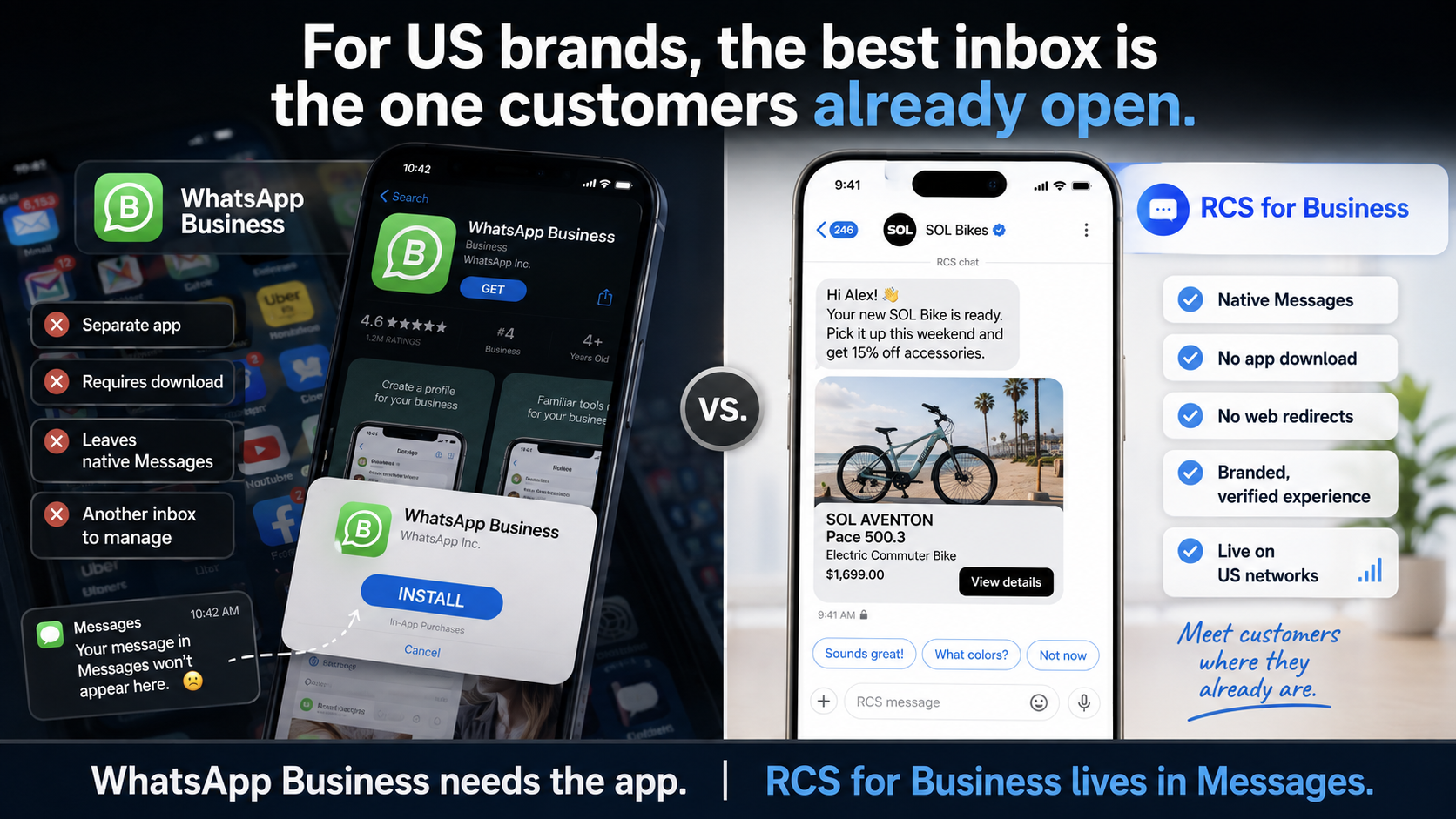
The core difference
WhatsApp Business is a standalone app. To receive a brand's message, the customer must have WhatsApp installed, keep it installed, and actually open it. That is a real adoption tax in a US market where the default Messages app is already the most-opened app on the phone.
RCS for Business is not an app. It is the carrier-backed upgrade to SMS that runs inside the same Messages app a customer already uses to text family and coworkers. There is nothing to download and no account to create. The brand shows up verified, with its name, logo, and checkmark, in the inbox the customer already checks.
Why the inbox matters more than the app
A messaging channel only works if the customer is in it. The single biggest reason brands add a new channel and see no lift is that customers never open the new app. Reach is not a feature you can bolt on after launch; it is the foundation.
- WhatsApp Business reaches customers who already use WhatsApp. In the US, that share is meaningful but far from universal, and it skews toward people who already adopted WhatsApp for personal use.
- RCS for Business reaches customers whose carrier, device, and operating system support RCS, which is the majority of modern Android devices on the major US networks. Where RCS is unavailable, the same message falls back to SMS so nothing is lost.
The honest trade-off is reach shape, not capability. WhatsApp is a walled app with global scale. RCS is the native inbox with strong US coverage and a built-in fallback.
What each channel gives the brand
| | WhatsApp Business | RCS for Business | | --- | --- | --- | | Where it lives | Separate app the customer installs | Native Messages app already on the phone | | Brand identity | Verified business profile in the app | Verified brand name, logo, and checkmark in Messages | | Rich content | Catalogs, media, quick replies | Rich cards, carousels, suggested replies, actions | | Two-way conversation | Yes, inside WhatsApp | Yes, inside Messages | | US reach | Customers who installed WhatsApp | Customers on supported carriers and devices, with SMS fallback | | App download required | Yes | No |
Both channels support branded, interactive, two-way messaging. The question for a US brand is not which one is more feature-rich; it is which inbox your customers actually open.
Where WhatsApp still wins
- Global reach into markets where WhatsApp is the default messaging app.
- Customers who already use WhatsApp daily and prefer it as their channel.
- Markets where RCS coverage is thin or carrier support is inconsistent.
Treating RCS as a replacement for WhatsApp everywhere is a mistake. Treating RCS as the native US-first channel, with WhatsApp as an additional surface for audiences that already live there, is how real multi-channel deployments are built.
How MessageOS uses it
MessageOS is a conversation layer. It provisions the verified RCS agent, runs the AI agent inside the thread, and connects the conversation to the systems a brand already operates, CRM, scheduling, commerce, and support. The brand gets one entry point that behaves consistently across site, ad, QR, email, and social, and the conversation resolves inside the native Messages app the customer already opens.
What any given brand can actually do in a thread depends on carrier and device support, brand verification and approval, the APIs and permissions your existing systems expose, and the compliance rules for your industry and region. MessageOS is the conversation layer on top of those systems, not a replacement for them.
The one-line version
WhatsApp Business needs the app. RCS for Business lives in Messages. For a US brand, the best inbox is the one customers already open.