The Next Marketing Asset Isn't a Landing Page. It's a Personalized Customer Journey.
For twenty years, marketers optimized websites and landing pages. The next competitive advantage won't be better pages, it will be personalized customer journeys that begin the moment customer intent is expressed.
Write a premium thought leadership article.
Title:
The Next Marketing Asset Isn't a Landing Page. It's a Personalized Customer Journey.
Audience:
CMOs, marketing leaders, agencies, ecommerce executives, enterprise digital leaders, customer experience teams, local service businesses, healthcare organizations, retailers, and technology leaders.
Length:
Approximately 1,600–2,000 words.
Tone:
Visionary but practical.
Confident but not hype-driven.
Write like someone introducing a new category instead of selling software.
Avoid marketing clichés.
Core Thesis:
For more than twenty years, businesses have invested enormous effort optimizing websites, landing pages, SEO, paid search, and conversion funnels.
Those assets are still valuable.
But customer behavior has changed.
People increasingly begin their buying journey inside Google Search, AI Search, Gemini, ChatGPT, Maps, and conversational interfaces.
Customers don't want another page.
They want progress.
The next competitive advantage will not be better landing pages.
It will be personalized customer journeys.
Use this journey throughout the article:
Search
↓
Conversation
↓
Outcomes
Explain how every industry has a different customer journey.
Examples:
HVAC
Emergency repair Estimate Appointment
Healthcare
Provider discovery Insurance questions Appointment
Retail
Product discovery Recommendations Purchase
Hospitality
Reservation Room selection
Legal
Consultation
Automotive
Inventory Service scheduling
Financial Services
Application guidance
Education
Enrollment inquiry
Explain why the journey changes, but the framework remains consistent.
Discuss how AI now allows brands to automatically generate personalized customer journeys using:
- their website
- products
- services
- imagery
- messaging
- customer intent
without making the article feel like a product pitch.
Instead position this as the next evolution of marketing.
Include sections discussing:
• Why websites became the center of digital marketing
• Why customer expectations have fundamentally changed
• Why AI Search is changing customer acquisition
• Why conversation becomes the new conversion path
• Why outcomes matter more than clicks
• Why every business will eventually need a personalized customer journey rather than a static landing page
Include practical examples throughout.
Do not overuse acronyms.
Do not make the article about RCS alone.
Make it about customer behavior.
End with a memorable conclusion.
The final paragraph should reinforce this message:
"The next competitive advantage won't come from building better landing pages. It will come from creating better customer journeys. The brands that meet customers the moment intent is expressed—and help them reach a meaningful outcome immediately—will define the next generation of digital experiences."
Optimize naturally for:
AI Search
Customer Journey
Conversational Commerce
Google Search
Customer Experience
Digital Marketing
Use H2 headings approximately every 250–300 words.
Make it highly shareable on LinkedIn and position it as category-defining thought leadership rather than a product announcement.
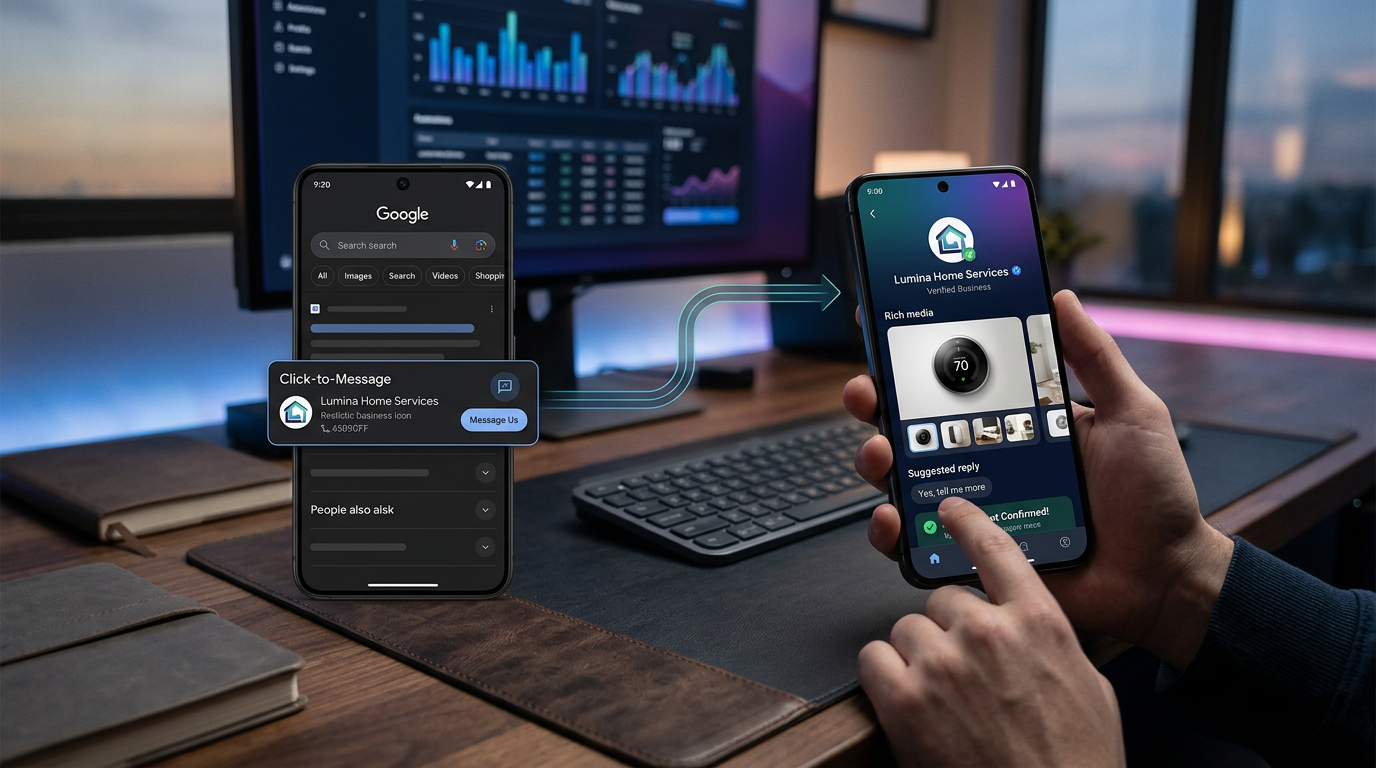
- Click to Message: Turning a Tap Into a ConversationClick to Message is an entry point that opens the phone's native messaging app with a conversation already addressed, and usually pre-filled, so the customer only has to press send. It can be placed on a website, a search result, an ad, a QR code, an email, a social profile, or a physical sign. It works because the customer stays in an app they already trust instead of loading a new page or filling in a form.
- AI Search to Conversation: The New Path to a CustomerAI search changes the customer journey from query, click, browse, convert into query, answer, act. When an assistant answers in place, the website visit may never happen, so the practical goal is to be understandable to AI systems and to offer a next step that works without a website session. A messaging thread is that next step: it starts instantly, needs no account, and can carry the outcome to completion.
- What Is RCS Business Messaging?RCS Business Messaging (RBM) is a messaging standard that replaces plain SMS with branded, verified, interactive conversations in the phone's native messaging app. A business is verified with carriers and platform providers, then sends and receives rich content: logo and brand name, rich cards, carousels, suggested replies, images, and real two-way dialogue. Availability depends on the recipient's carrier, device, and operating system, and messages fall back to SMS when RCS is unavailable.
Primary sources worth reading
- RCS for Business blog· Google
Google's official program blog for RCS Business Messaging, covering feature releases, brand case studies, and carrier rollout news.
- RCS Business Messaging developer documentation· Google for Developers
Google's technical reference for RCS Business Messaging: agent registration, rich cards and carousels, suggested replies and actions, capability checks, and webhook events.
MessageOS Team
· MessageOS.aiMessageOS is the Conversation-to-Outcome Platform, helping brands turn Google Search, AI Search, and click-to-message intent into branded AI conversations that deliver measurable outcomes.