Demystifying Google UCP: Shifting Messaging Infrastructure from Cost Center to Revenue Engine
Enterprise value in CPaaS has shifted from the transport layer to the intelligence layer. Here is what Google's Universal Commerce Protocol (UCP) is, and how MessageOS detects and displays UCP data in RCS.
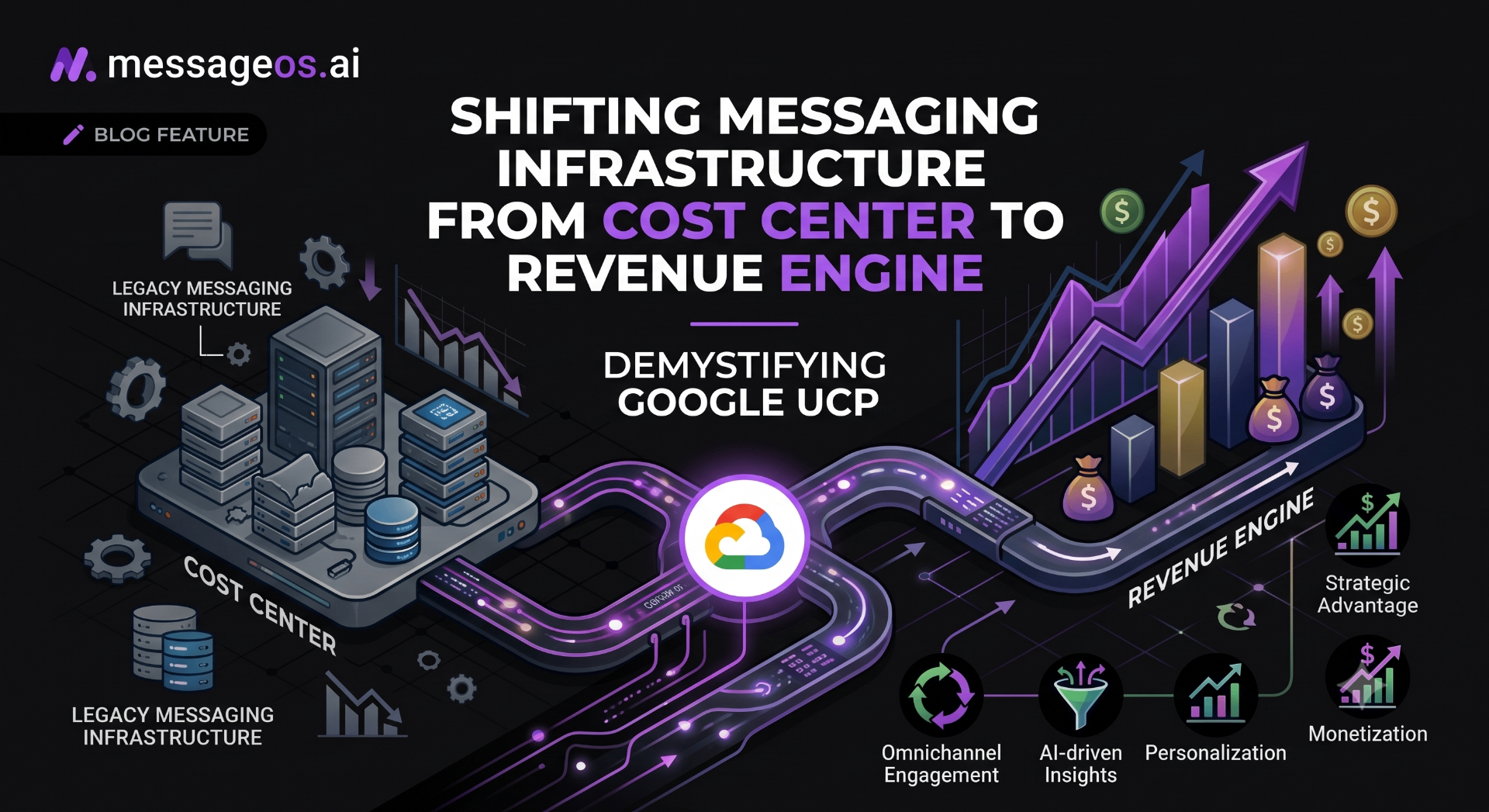
For years, Enterprise CPaaS (Communications Platform as a Service) vendors focused almost exclusively on the transport layer: delivery rates, throughput, and optimizing fractions of a cent across millions of automated text alerts and 2FA codes.
But pure volume is a race to the bottom. The real enterprise value has officially shifted from the transport layer to the intelligence layer.
What is Universal Commerce Protocol (UCP)?
The Universal Commerce Protocol (UCP) is an open standard for agentic commerce that Google announced on January 11, 2026, co-developed with Shopify, Etsy, Wayfair, Target, and Walmart. It gives AI agents and merchants a common language for product discovery, cart, checkout, and post-purchase steps, and Google's own UCP surfaces today are AI Mode in Search and Gemini.
Google hasn't announced UCP in RCS for Business or Google Messages. MessageOS built UCP detection into its own live RCS agent, so a brand can see the products and capabilities its store publishes through UCP displayed in a verified, branded RCS thread. For the full, sourced explainer, read our guide: UCP in RCS.
UCP runs over REST APIs, Anthropic's Model Context Protocol (MCP), and Agent2Agent (A2A), and it is compatible with the Agent Payments Protocol (AP2), so agents get one standard way to discover what a merchant supports and to work with its checkout and payment systems.
The Technical Shift: Legacy CPaaS vs. Agentic Commerce
| Feature | Legacy CPaaS Model | Agentic Commerce Model (UCP) |
|---|---|---|
| Primary Metric | Delivery Rates and SMS Throughput | Transaction Velocity and Conversion |
| Data Payload | Static Text / Media Templates | Dynamic State and Intent Routing |
| Checkout Layer | External Web URL Redirect | Standard checkout capability the merchant publishes through UCP (Google's surfaces: AI Mode and Gemini) |
| Merchant Role | Passive Content Distributor | Merchant of Record, keeps customer data |
| Where MessageOS fits | Bulk one-way sends | The MessageOS live RCS agent detects a store's UCP profile and displays it in a verified RCS thread |
How MessageOS Uses UCP in RCS
A store that supports UCP publishes a profile that declares what it can do. The MessageOS live RCS agent reads it in three steps:
- Try your brand: Enter your brand or store at messageos.ai/message.
- Detect: The agent checks whether your store publishes UCP, and which capabilities it declares.
- Display: The agent shows what it finds, such as your products and UCP capabilities, in a verified, branded RCS for Business conversation in the native Messages app.
Building for 2026 and Beyond
If your enterprise messaging vendor is still pitching you bulk SMS packages instead of dynamic agent interfaces, your stack is rapidly deprecating. Standardizing the discovery-to-checkout layer via open commerce protocols is no longer an experimental feature, it is the baseline requirement for modern customer experience architecture.
Read our guide to UCP in RCS for the sourced details, then try your brand to see what the MessageOS live RCS agent detects for your store.
- What Is RCS Business Messaging?RCS Business Messaging (RBM) is a messaging standard that replaces plain SMS with branded, verified, interactive conversations in the phone's native messaging app. A business is verified with carriers and platform providers, then sends and receives rich content: logo and brand name, rich cards, carousels, suggested replies, images, and real two-way dialogue. Availability depends on the recipient's carrier, device, and operating system, and messages fall back to SMS when RCS is unavailable.
- AI Search to Conversation: The New Path to a CustomerAI search changes the customer journey from query, click, browse, convert into query, answer, act. When an assistant answers in place, the website visit may never happen, so the practical goal is to be understandable to AI systems and to offer a next step that works without a website session. A messaging thread is that next step: it starts instantly, needs no account, and can carry the outcome to completion.
- RCS Integrations: How the Conversation Layer Connects to Your StackMessageOS connects to the systems a business already runs, CRM, scheduling, commerce, support, payments, and analytics, and uses them to answer questions and complete actions inside a messaging thread. Integration happens through those systems' APIs and webhooks, so the agent's real capability is bounded by what each system exposes and what permissions it is granted. MessageOS enhances that stack rather than replacing any part of it.
Primary sources worth reading
- RCS Business Messaging developer documentation· Google for Developers
Google's technical reference for RCS Business Messaging: agent registration, rich cards and carousels, suggested replies and actions, capability checks, and webhook events.
Jennifer at MessageOS
· MessageOS.aiMessageOS is the Conversation-to-Outcome Platform, helping brands turn Google Search, AI Search, and click-to-message intent into branded AI conversations that deliver measurable outcomes.